
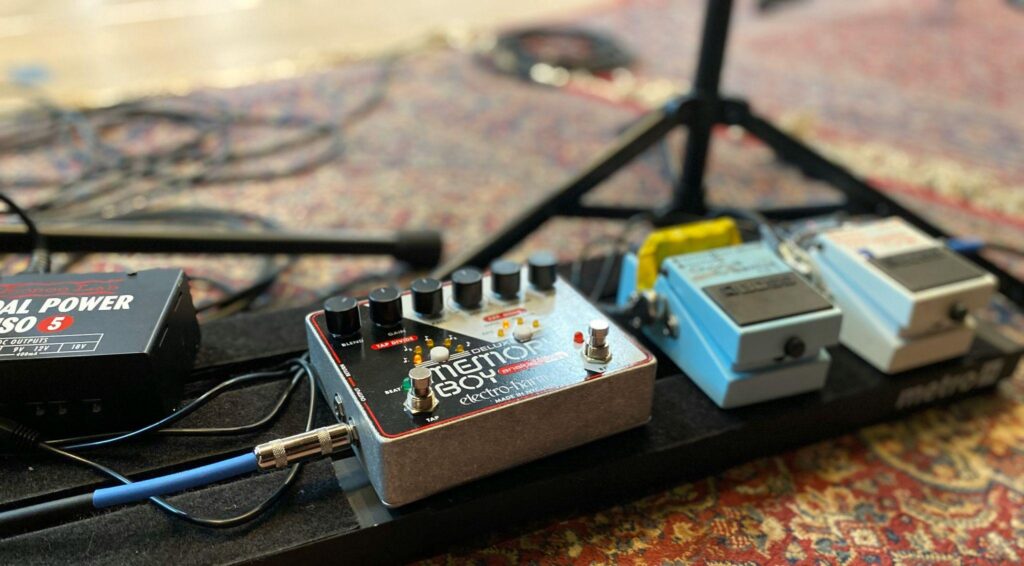
The pedalboard controversy is surprisingly intense in guitar circles. Some musicians adhere to simple signal networks in which each pedal gains its position from frequent use. Others construct complex systems that span several boards, branching into parallel effect loops and routing signals through switchers. Neither strategy is intrinsically better; both are effective. The ideal arrangement is totally dependent on the demands of the music, the player’s approach to tone, and the practicalities of moving guitar pedals from the rehearsal space to the stage and back.
What a Compact Setup Actually Offers
A modest pedalboard with three to six pedals requires discipline that larger setups rarely acquire spontaneously. In order to create chains where each unit is truly needed rather than present out of habit or the hazy notion that more options equal better outcomes, each included pedal must defend its existence against alternatives.
Compact configurations don’t require complicated current calculations and can be powered by a single isolated supply unit. They travel without the hassles of checked baggage, fit into compact bags, and set up in minutes as opposed to the lengthy ritual required by huge systems. Over the course of a tour, these useful benefits add up to something significant for musicians who perform frequently at various locations.
Signal integrity is a key component of the sonic argument for compact setups. Even when bypassed, each pedal in a chain adds a certain amount of signal deterioration. The natural dynamics and frequency response of the guitar are better preserved by shorter chains with fewer bypass points than by longer ones.
Where Larger Setups Make Sense
Players whose musical range truly demands sounds that can’t be produced with fewer tools benefit from a larger pedalboard. More resources are required when a guitarist performs a variety of styles, such as ambient textures, saturated rock, driving blues, and crisp country tones.
Players who have transitioned from general-purpose multi-effect units to dedicated specialised pedals for each function will also benefit from larger setups. A particular reverb chosen for its spatial character, a particular overdrive selected for its response to picking dynamics, and a carefully selected modulation pedal all occupy space that a general-purpose unit might cover with a single footswitch. For players with established tastes, the trade-off in physical size results in sound distinctiveness.
Large setups with switching systems enable intricate signal routing without having to bend between songs to change several pedals at once. Instead of being conceptually comprehensive but operationally chaotic, programmable switchers make complex settings truly practical in practice by recalling whole configurations with a single tap.
The Signal Chain Question
Tone is influenced by the arrangement of pedals in a chain just as much as the selection of individual units. Compressors and volume controls are examples of dynamic pedals that are usually positioned early in the chain to manipulate the signal before it reaches gain stages. The fundamental amplified tone is shaped by the overdrive and distortion pedals that come next. Chorus and phaser are examples of modulation effects that typically function best after gain stages. Time-based effects, such as reverb and delay, handle the entire formed signal instead of being modulated or distorted.
These ideas hold true for both small and big setups, although longer chains present greater opportunities for ordering choices to have unanticipated effects on tone. When a particular sound calls for it, players might purposefully depart from the standard order by knowing why it yields the desired outcomes.
Power Supply Considerations
Players frequently don’t know how important it is to power pedals correctly until they experience issues. When digital and analogue pedals share the same supply, daisy-chaining power from a single source creates ground loop noise that shows up as hum or interference. An isolated power supply provides separate regulated outputs for each pedal, which eliminates this issue.
Because compact systems require fewer outputs and less current capacity, choosing the right power supply is simple. In order to satisfy the whole demand cleanly in larger installations, it is necessary to carefully calculate the total current draw, identify pedals with peculiar voltage or polarity requirements, and occasionally use multiple power units.
Starting Point for New Builders
When building their first pedalboard, players should start smaller than they believe is necessary. Most musical situations can be covered by starting with a tuner, one or two gain settings, and one ambient effect. This allows for the identification of specific gaps that further pedals might fill. Compared to developing a sizable collection speculatively, adding pedals in response to real, identified needs results in a more cohesive and personally meaningful configuration.
Neither the biggest nor the smallest pedalboard is the most efficient. It is the one where each element immediately adds to the sounds that the song truly needs.