
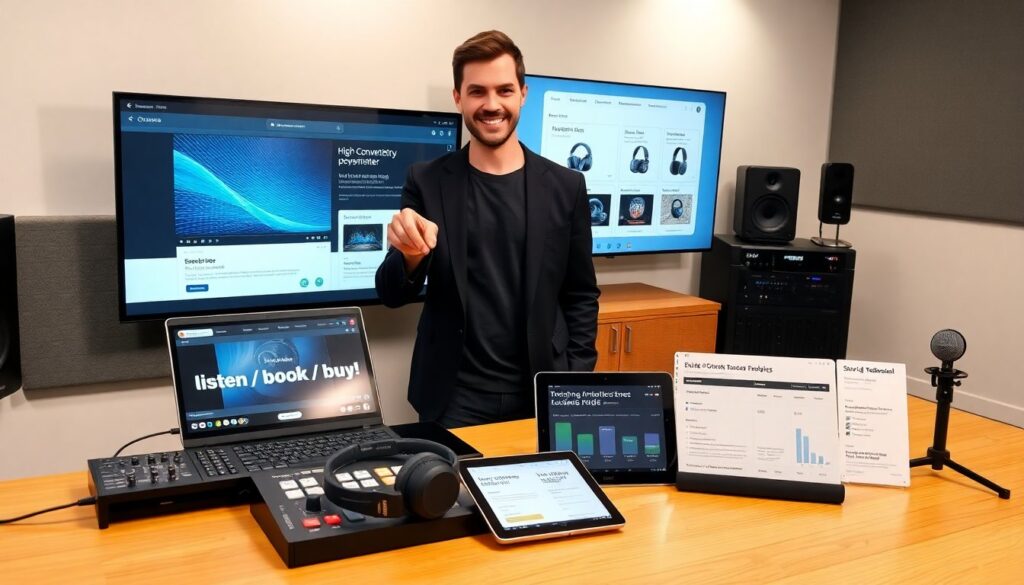
music technology prositesite helps professionals show gear, demos, and services online. The guide shows clear steps to set up pages, host audio, and accept bookings. It lists tools that serve audio, MIDI, and live streaming. The reader will get a checklist, configuration tips, and traffic ideas. The article keeps language simple and action focused.
Key Takeaways
- A high-converting music technology prositesite prioritizes user experience with fast loading, clear gear visuals, seamless demo playback, and straightforward booking options.
- An effective tech stack integrates mobile-friendly audio players, MIDI controls, live streaming, secure payment gateways, and licensing servers to enhance functionality.
- Organize site content by user intent across home, gear, demo, and service pages, using simple calls to action and social proof to increase conversions.
- Implement hosting with CDN support, media-capable CMS, analytics-linked audio players, and secure delivery methods including signed URLs and adaptive streaming.
- Track site performance through detailed analytics of plays, downloads, conversions, and conduct A/B testing to optimize headlines and visuals.
- Maintain site security and performance by enabling SSL, using CSP headers, minimizing assets, and performing regular deployment and license checks.
What Makes A High-Converting Music Technology Pro Site
A high-converting music technology prositesite puts the visitor first. The site loads fast. The site shows gear images and clear specs. The site plays demos without extra clicks. The site shows services, prices, and booking options. The site uses simple calls to action like “listen,” “book,” and “buy.” The site offers social proof. The site uses client logos, short testimonials, and demo stats.
The site organizes content by user intent. The home page guides visitors to demos, gear pages, or service pages. The gear page lists features, compatibility, and sound clips. The demo page names the track, lists session details, and shows the processing chain. The service page lists deliverables, timelines, and payment methods.
The design supports conversion. The navigation stays visible. The player remains available on scroll. The contact or booking form appears in two places. The checkout uses one page for fewer drops. The site uses clear language and consistent visuals. The site avoids long paragraphs. The site uses short headings and bullets. The team updates demos monthly to keep content fresh.
A music technology prositesite tracks outcomes. The site records plays, downloads, and conversions. The site tests headlines and images. The site runs small ad tests to find the best channels. The site keeps an email list and sends focused updates. The site asks for feedback after service delivery. The team refines the site based on data.
Essential Tech Stack And Integrations For Audio, MIDI, And Streaming
A solid tech stack powers a music technology prositesite. The stack serves audio playback, file delivery, MIDI interaction, and live streams. The stack balances performance, cost, and ease of use. The stack integrates with the CMS and analytics. The stack secures files and protects licensing.
The stack uses a CMS that handles media. The CMS stores pages, artist bios, and blog posts. The CMS links to audio players and embed codes. The CMS supports custom fields for gear specs and demo metadata. The CMS offers role-based access so the team updates demos without exposing admin tools.
The stack includes audio players that work on mobile. The player supports gapless playback, rewinding, and waveform views. The player supports deep links to timecodes. The player logs plays for analytics. The player accepts secure streaming tokens for paid content. The player integrates with purchase and download flows.
The stack connects MIDI tools for demo control. The site can embed a simple MIDI controller widget for demo manipulation. The widget sends MIDI control messages to a hosted synth or sample engine. The widget uses WebMIDI or a fallback UI for browsers that block MIDI. The widget stores user presets for replay.
A music technology prositesite uses APIs for licensing and payment. The site links to payment processors for one-off sales and subscriptions. The site uses license servers to issue download keys. The site verifies keys at download time. The site stores minimal user data and follows privacy rules.
The stack plans for live streaming. The site uses an encoder service to push RTMP. The service transcodes to HLS for browsers. The site adds chat and ticketing for paid streams. The site records streams and exposes them as on-demand demos. The site optimizes bitrates for mobile and desktop.
Hosting, CMS, Audio Players, Delivery, And Analytics (Setup Checklist)
Hosting
- Choose a host that serves audio quickly. Pick a host with CDN support. Pick a host with easy SSL and backups. Pick a host that scales for streams.
CMS
- Use a CMS that supports media fields. Use role-based editing. Use templates for gear and demo pages. Use simple URL patterns for SEO.
Audio Players
- Pick a player that supports HLS and progressive MP3. Pick a player with waveform and cue points. Pick a player that logs plays to the site analytics.
Delivery
- Store large files on object storage with CDN. Use signed URLs for paid downloads. Deliver stems and multitracks as ZIPs. Offer lower-bitrate streams for mobile.
MIDI & Widgets
- Add a WebMIDI fallback widget. Host the synth engine on a secure subdomain. Store user presets in local storage or a minimal account.
Streaming
- Use an encoder that accepts common sources. Use adaptive bitrate output. Use HLS playback in the embedded player. Keep chat and ticketing on the same domain to reduce friction.
Payments & Licensing
- Use a stable payment gateway. Support subscriptions and one-time purchases. Use license keys for paid downloads. Send receipts automatically.
Analytics & Tracking
- Track plays, downloads, conversions, and user paths. Use event-based analytics for player interactions. Use A/B tests for headlines and thumbnails. Link analytics to the CMS for content reporting.
Security & Performance
- Enable SSL and HSTS. Use CSP headers for players. Minify assets and defer non-critical scripts. Audit load times with real user metrics.
Maintenance
- Set deployment checks for audio rendering and player logs. Run monthly checks on expired licenses and broken embeds. Keep dependencies up to date.
A clear checklist helps the team launch and maintain a music technology prositesite. The list reduces surprises and keeps the site reliable for artists, clients, and listeners.